
DIY (Do It Yourself) Guide – Installing a Drip Irrigation System
A Basic Guide For Installing A Drip Irrigation System

Basic of drip irrigation
The initial step requires mapping your garden or plantation to determine how the irrigation system is going to be placed and which plants you would like to use the system on. There are many types of accessories that you can find for various types of plants; spray and emitters are often used on the ground. The tubing can be obtained from a manufacturer either already punched with emitters attached every 18 inches or not perforated meaning that you will have to make the necessary holes and place the emitters. Buying the tubing not perforated is ideal to customize according to your garden needs. There are many different types of tubing also, it is therefore necessary to inquire accordingly especially what is best for the type of soil; for instance, around Perth in Western Australia the dripline should be suitable for sandy soil. For best solution, you should have separate pipes for each type of plants that you have because each group of plants will have different water requirement. Therefore, vegetables, natives, and fruit trees all require different amount of water. Note that where you make the holes for the drippers will determine also the quantity of water. Holes places 15 cm apart will discharge 19 litres of water per hours while at 30 cm the quantity of water discharged per hour would be 40 litres per hour per square meter.
Your water source
Your water source can be obtained from any outdoor faucet. You may want to use a y-shaped valve to obtain extra lateral for other water needs that you might have. If using a y-shaped valve, it should be placed upside down such that the “Y” with the faucet attached to the y making the water flow upward in to the tubes.
Drip tubing

There are different sizes of tubes ideal for certain types of plants. Generally the drip tubes are small sized varying between 12mm, 16mm and 18mm. the emitters should never be buried underground. There are special emitters that can be purchased if you want to bury emitters underground.
Types of emitters and flow
Emitters are what control the flow of water. To the tubing either by screwing or snapped onto it. There are many different types of emitters the most common having the capacity of 2litre/hr; 4 litre/hr, or 8liter/hr. The majority of emitters are classified according to their design and how they control water. Some types of emitters include: Long-path emitter, soaker hole, porous, pipe, drip tape, laser tubing, short-path emitters, tortuous path, and vortex emitters. Choosing the type of emitter is necessary to regulate the flow of water. Often, you must take into consideration the type of plant being irrigated and the quantity of water required daily.
Installing a drip irrigation system are shown in the figure:
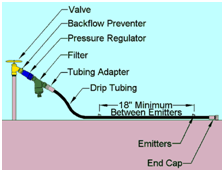
The majority of drip systems operate at a lower pressure than that which is common on water pipes. A pressure regulator helps regulate the water pressure by keeping it at a low pressure. A pressure regulator is probably needed if the water pressure is more than 2.8 bars. The pressure regulator only reduces water pressure and does not increase it.
Even if you are using clean water from the house, you need to use a filter. The filter will clean the water; emitters often have very small holes and can easily become clogged. The water in the house are not also completely clean; grains of sand, rust from the pipes are not uncommon. Filtering the water is essential to prevent any unfortunate incidents.
Tubing adapter are for connecting the pipe to the water system. They are often made for connecting the hose thread from one end and the pipe thread from the other end.
The tubing itself will have emitter at interval distance. The layout of the tube is essential to take into consideration as well as the quantity of water needed. The tubing length should not be more than 60 meters as noted earlier
The end cap. Obviously having an end cap is necessary unless you want all the water to flow out on the other side. Water in a drip tube flow quite slowly allowing for sediments to settle. Overtime the sediments build up and require being flushed out. This often can be done once a year. Some climates also have algae that build and require flushing, algae flushing should be done more often.
Online Garden Design offering unique landscape designs. Professional landscape designers – Landscape design packages and do it yourself landscape guides. Landscape designs/garden plans for garden makeovers, renovations or landscaping plans for new house builds. Online Garden Designs Australia wide including Sydney, Melbourne, Brisbane, Perth, Adelaide, Canberra, Darwin, Hobart